One Board, Many Hands: The Bath Potluck Grazing Party That Looks Anything But Random
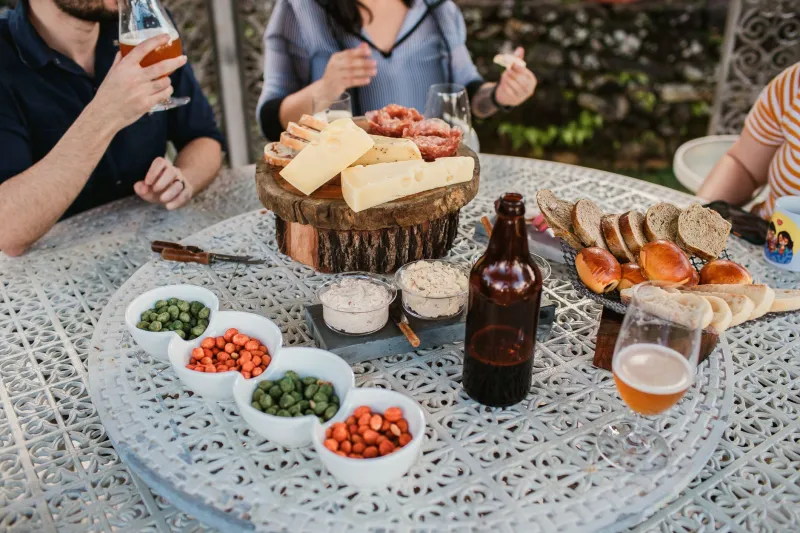
There is a particular kind of Bath gathering that suits a shared table down to the ground: a birthday in a flat off Walcot Street, a housewarming in a tall Georgian terrace with a kitchen the size of a wardrobe, a Sunday lunch that has quietly turned into supper for fourteen. The bring-a-board grazing party works because it spreads the cost and the cooking without spreading the chaos — provided someone takes charge of the shape of the thing.
That someone is you. Not the cook, necessarily. The host as curator: the person who assigns lanes, keeps the table looking deliberate, and makes sure nobody leaves a bowl of houmous on a windowsill for four hours.
Why a shared board works in Bath
Bath kitchens are not designed for buffet service. Many of us are working with galley counters, narrow hallways and a dining table that doubles as a desk. A grazing table is forgiving of all that. It can be built in stages, laid out on several boards rather than one long run, and topped up as the afternoon or evening goes on.
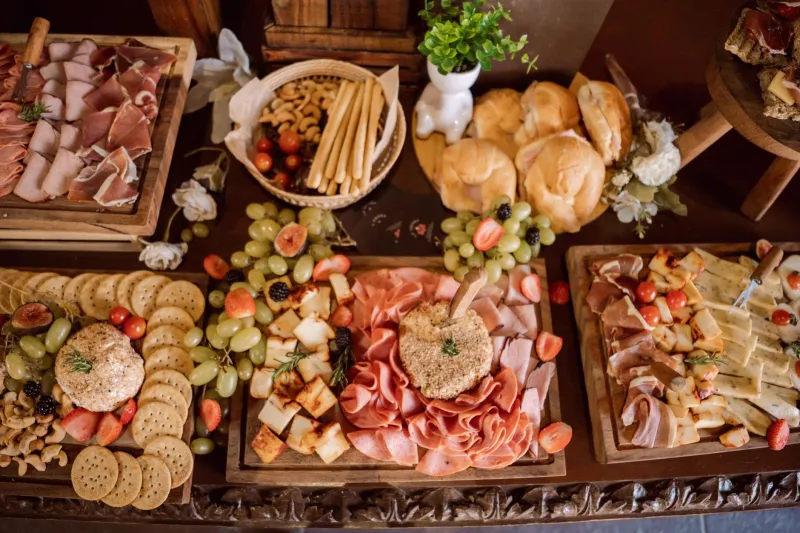
It also solves the potluck problem. A traditional bring-a-dish party can end up with six pasta bakes and no salad. A grazing table is modular by nature: cheese here, cured meat there, pickles in small bowls, bread in a basket, fruit and nuts to fill the gaps. If two people bring cheddar, it is not a disaster — it is a cheese board with a theme.
But a little structure makes it look intentional rather than accidental.
The lane system: assign categories, not dishes
Instead of telling guests to “bring something”, give them a lane. Six lanes work well for a group of ten to sixteen. The host covers the base: boards, bowls, labels, knives, crackers, a decent olive oil, and perhaps one anchor piece — a whole baked Camembert or a baked ham — to give the table a centre.
- Cheese — one person per cheese style, not one per cheese. A soft, a blue, a hard, a goat’s. If two people want to bring cheese, ask one to bring a chutney instead.
- Cured meat and fish — sliced prosciutto, salami, smoked salmon, a pot of rillettes. Keep it to two or three contributors so the table does not become a charcuterie counter.
- Pickles, ferments and preserves — cornichons, olives, kimchi, pickled beetroot, a jar of good chutney. These are cheap, keep well, and make the table look abundant.
- Bread and crackers — one person brings a decent sourdough or focaccia, another brings crackers and maybe a flavoured flatbread. Ask them to slice it before arrival.
- Fruit, nuts and something fresh — grapes, figs, apple slices with lemon, radishes, cherry tomatoes, a bowl of walnuts. This is the lane that keeps the table from feeling heavy.
- Something sweet — one small sweet thing, not a full dessert. Brownies cut small, a lemon drizzle sliced thin, a bowl of salted caramel truffles.
If the group is larger, split the cheese and bread lanes in two. If it is smaller, merge sweet with fruit and ask the cheese person to bring two styles.
The sign-up message that does the heavy lifting
You do not need an app. A group chat and a shared note will do. Copy this and adjust:
Bring-a-board: [date], [time], [address] Reply with:
- Your lane (cheese / cured meat & fish / pickles & preserves / bread & crackers / fruit, nuts & fresh bits / something sweet)
- What you’re bringing — be specific
- Any allergies or dietary needs in your household
- Whether you can bring a board, bowl or serving knife
I’ll provide the boards, labels, crackers, oil and the anchor dish. Please bring your item ready to serve — decanted, sliced, at room temperature unless it needs the fridge.
Specificity is everything. “Cheese” is not a plan. “A wedge of Montgomery cheddar and a jar of piccalilli” is a plan. Ask guests to reply in the chat rather than privately so everyone can see what is already claimed.
Allergies, diets and the awkward conversation
Ask early, ask plainly, and do not guess. The sign-up message gives people a private-enough route to say “coeliac” or “severe nut allergy” without making a speech at the table.
On the day, label everything. Small paper tags or luggage labels work well: contains nuts, gluten-free, vegan, contains shellfish. Keep a separate small board for gluten-free bread and crackers, with its own knife. Put vegan cheese on its own plate with its own knife, not next to the Stilton. If someone has a serious nut allergy, keep the nuts in a sealed bowl at the far end of the table and use a separate serving spoon.
It is also worth asking guests not to bring homemade preserves or ferments if they cannot confirm the ingredients. Shop-bought labels are easier to trust when someone is managing a serious allergy.
Sourcing the shared table in Bath without overspending
The beauty of a potluck is that the cost is spread. Set a rough cap per household — £8 to £12 is plenty for most lanes if people shop sensibly — and say so in the message. It takes the anxiety out of it.
For cheese and charcuterie, Guildhall Market is hard to beat for variety and conversation. Paxton & Whitfield and The Fine Cheese Co. are the special-occasion stops; buy a whole small cheese rather than a pre-cut wedge and you will usually get better value and better keeping. Green Park Station’s Saturday farmers’ market is the place for bread, seasonal fruit, local charcuterie and pickles. Bertinet and Landrace are reliable for loaves that hold up on a board. Walcot Street’s independents are good for olives, oils and the kind of jarred things that make a table look generous for very little.
A few budget habits help: shop late on market day, buy fruit in season, make your own quick pickled onions, and ask guests to bring what they already love rather than chasing a theme.
Styling it so it looks intentional
A potluck table looks cohesive when the host controls the scenery. Use plain boards — wood or slate — and keep bowls roughly the same size and colour. A roll of brown paper down the middle of the table can unify mismatched surfaces. Small labels, a few sprigs of thyme, and a couple of low candles do more than any elaborate centrepiece.
Ask guests to decant: no clingfilm, no supermarket tubs, no half-empty packets. Provide a staging area in the kitchen where items can be transferred to boards and bowls. Keep the table from overcrowding by building in waves: start with cheese, meat, pickles and bread; add fresh items and warm things later.
Timing the build and keeping things safe
This is the part that separates a relaxed host from a frazzled one. Keep cold items in the fridge until the last possible moment. Use ice packs under boards if the room is warm. Do not leave cheese, cured meat, dairy or cooked meats out for more than two hours — less if the heating is on.
Build in small amounts and replenish from the kitchen rather than putting everything out at once. It looks better, keeps food fresher, and gives you a reason to move around the room. Warm items — a baked Camembert, some falafel, a tray of roasted vegetables — can go in halfway through, when the first wave has been picked over.
A simple running order
The day before: confirm the sign-up list, label your own boards and bowls, make a quick pickle, check the fridge space.
The morning: shop for the base items, set out boards and labels, chill drinks.
One hour before: lay out the non-perishable lanes — crackers, nuts, fruit, pickles, bread.
When guests arrive: take their items, decant what needs decanting, and thank them by name for the thing they brought. That is the whole point of a shared table: everyone can see their contribution.
Halfway through: replenish, add warm items, clear empty bowls.
At the end: wrap what is safe to keep, bin what has been out too long, and send people home with a slice of someone else’s cake.
The board does not need to be perfect. It needs to feel like a room full of people who each brought one good thing, and a host who made it look easy.